How to Work Through Difficult Relationships? Release the Pain of the Past and Regain Inner Peace
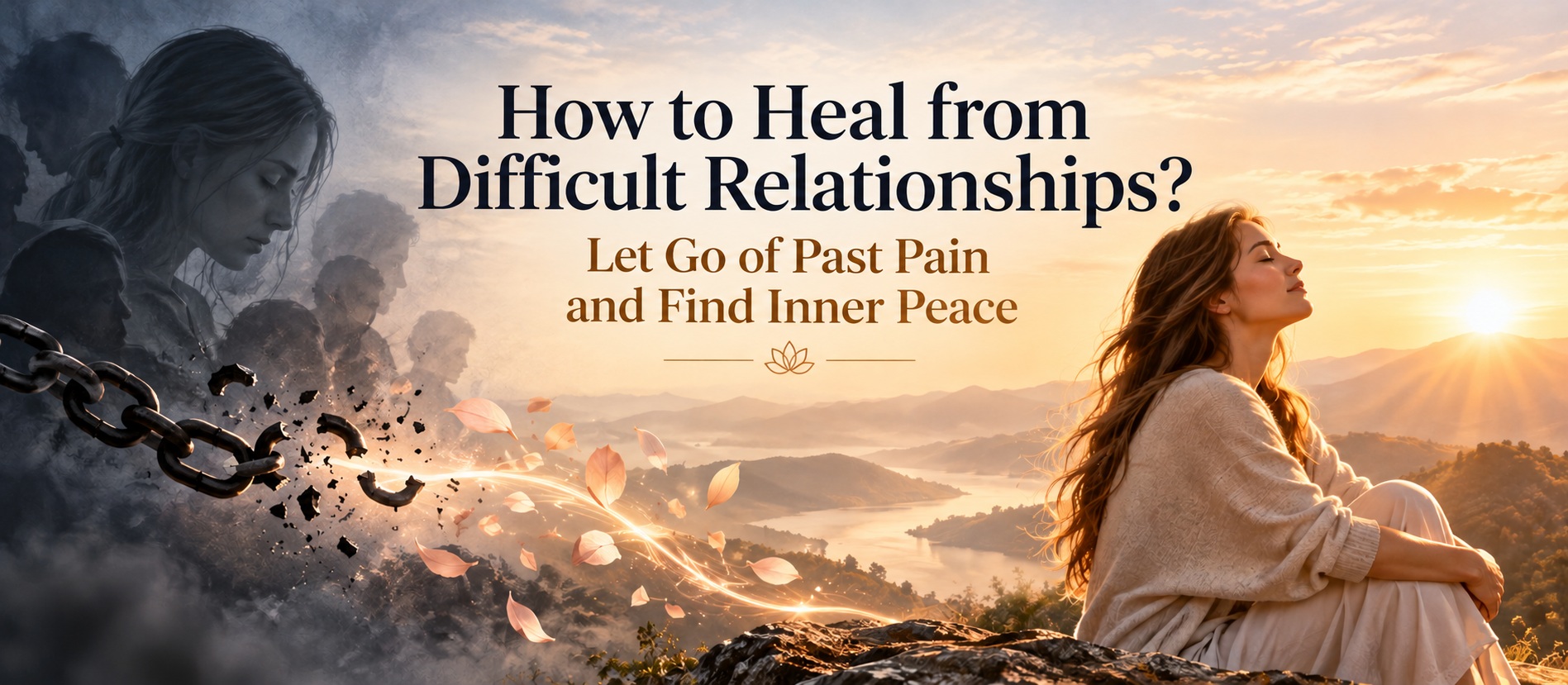
How to Work Through Difficult Relationships?

Let Go of Past Pain and Find Inner Peace
Have you ever found yourself thinking about a conversation that took place many years ago? About words that hurt you? About a relationship that ended but left you with resentment, sadness, fear, or a sense of injustice?
Perhaps the person with whom you shared that difficult experience has not been part of your life for a long time. And yet, remembering them still brings up strong emotions.
Sometimes a similar situation, a single sentence, or someone's behavior is enough to bring old pain back to the surface.
A difficult relationship may end, but the way we experience and interpret it can continue to influence our lives for many years.
Over time, certain experiences begin to shape our beliefs: about ourselves, other people, love, trust, and even the world itself.
We may unconsciously close ourselves off from intimacy, expect to be hurt again, or view new situations through the lens of what happened in the past.
But must we carry this burden throughout our entire lives?
We cannot always change what happened to us. But we can gradually change the way that experience lives within us today.
From the perspective of 5D Vibration, this is where an important journey begins: from pain, fear, and a sense of being wronged toward greater awareness, understanding, acceptance, and love.
It is the journey from I WANT to I LOVE.
It is not about forgetting or pretending that nothing difficult happened.
It is about reclaiming an inner space where the past no longer has to determine our ability to love the present.
Why Do Difficult Relationships Leave Such a Deep Mark on Us?
Human beings are social by nature. We need closeness, safety, acceptance, respect, and a sense of belonging.
That is why relationships with other people have such a profound influence on our emotional lives.
When we experience betrayal, rejection, humiliation, abuse, injustice, or the loss of an important bond, our suffering may involve more than the event itself.
It may also change the way we begin to see ourselves and the world.
Someone who has been betrayed may begin to believe:
"No one can be trusted."
Someone who has experienced rejection may think:
"I do not deserve love."
A person who has repeatedly faced criticism may develop the belief:
"No matter what I do, I will never be good enough."
Over time, thoughts like these can become an almost automatic way of interpreting reality.
In psychology, this is related to deeply held beliefs and cognitive schemas. They influence what we notice, what we fear, and how we respond to others.
The difficulty begins when one painful experience becomes the filter through which we view our entire lives.
It is important to remember, however, that especially after traumatic experiences, our reactions may also be connected to automatic stress responses. Changing our thoughts alone is not always enough to make difficult emotions disappear immediately.
Working with our perspective can be very helpful, but sometimes we also need time, safe relationships, and professional support.

When the Past Begins to Control the Present
Imagine that many years ago someone seriously betrayed your trust.
Today, you meet someone new who treats you with kindness. You want to build a good relationship, but tension begins to arise within you.
You start looking for signs of danger. You analyze every word. You fear that history will repeat itself.
Perhaps this new person has done nothing to justify such a level of distrust.
Yet your reaction is partly connected to an earlier experience.
We do not always react only to what is happening now. Sometimes we also react to what hurt us in the past.
A similar pattern may appear in family relationships, romantic partnerships, friendships, and professional relationships.
Unexpressed resentment, persistent fear, or a sense of injustice may influence our choices, communication, and willingness to connect with others.
In spiritual language, such an experience is sometimes described as an energetic blockage.
At 5D Vibration, we can understand this concept as a metaphor for inner tension, a feeling of being stuck, and a reduced sense of freedom in experiencing and expressing love.
It is not a medical diagnosis or a scientifically established mechanism through which diseases develop.
We do know, however, that chronic stress can affect mental and physical health. This does not mean that someone who becomes ill caused their illness through unresolved emotions.
The purpose of this work is not to find fault within ourselves. It is to reclaim greater awareness, peace, and freedom of choice.
What Does Healing from a Difficult Relationship Really Mean?
Healing from a difficult relationship does not mean erasing memories.
Nor does it mean that we must consider harmful behavior acceptable, trust someone who hurt us again, or rebuild a relationship that has ended.
Healing means gradually reclaiming influence over how we relate to our own story and how we allow it to affect the present.
We can remember a difficult event without endlessly replaying the same inner struggle.
We can understand that someone treated us unfairly without building our entire lives around anger toward that person.
We can miss someone we have lost and gradually discover gratitude for the time we shared.
We can accept the fact that the past cannot be changed without giving up our right to experience our emotions.
The goal is not for the memory to cease to exist. The goal is for it to no longer continually take away our peace.
How to Heal from Difficult Relationships: 7 Steps Toward Inner Freedom
There is no single method that will help every person in exactly the same way.
However, we can develop practices that support a deeper understanding of our emotions, help us recognize deeply held beliefs, and encourage a more conscious relationship with the past.
Consider the following seven steps an invitation to work gently with yourself, not an obligation to get rid of your pain quickly.
1. Pause and Notice What Still Lives Within You
The first step is awareness.
Instead of automatically pushing away a difficult memory or becoming absorbed in the same thoughts once again, try to notice what arises within you.
You can ask yourself:
"What exactly hurt me?"
"What emotions arise
when I return to this situation?"
"Do I feel resentment, anger, fear,
shame, longing, or guilt?"
"What did I need most
at that moment?"
You do not have to change anything immediately.
Noticing your own experience is the beginning of a conscious relationship with it.
If a memory triggers very intense reactions, feelings of disconnection, panic, or difficulty returning to everyday life, do not force yourself to continue analyzing it.
In such situations, working with a qualified professional may be a safer approach.
2. Acknowledge Your Pain Without Judging Yourself
Sometimes we try to free ourselves from suffering by saying:
"I should not still be thinking about this."
"So much time has passed."
"Other people have it worse."
"I have to be strong."
Yet words like these may add self-criticism to the pain we already carry.
Try a different approach:
"That was difficult for me."
"My feelings matter."
"I do not have to pretend
that nothing happened."
"I can learn to care for myself
even when I am suffering."
Accepting your pain does not mean accepting the harm. It means acknowledging the truth of your experience.
Self-love also begins where we stop punishing ourselves for being human.
3. Recognize the Beliefs That Formed After a Difficult Experience
The event itself and the meaning we later give it are not always the same.
If someone betrayed you, the fact is that this person broke your trust.
But the belief:
"Everyone betrays people."
is a generalization that may influence your future.
Similarly:
"Someone rejected me."
does not mean:
"I do not deserve love."
Try asking:
"What actually happened?"
"What meaning did I give this experience?"
"Does my belief describe a fact,
or is it an attempt
to protect me from being hurt again?"
"Is there another,
more realistic perspective?"
Not every belief formed in a moment of suffering has to remain the truth by which we live.
This is not about replacing reality with artificial optimism.
It is about reclaiming the ability to see the world more broadly than through the lens of a single painful experience.
4. Look at Your Story Through Understanding and Love
When we return to a difficult relationship, we often direct all our attention toward the other person's behavior.
We analyze why they acted that way, what they should have said, and how everything might have turned out differently.
Yet an important part of healing may involve directing some of that attention toward ourselves.
Not to blame ourselves, but to understand our needs, reactions, and protective patterns.
Ask yourself:
"What did I need back then
that I did not receive?"
"How was I trying to protect myself?"
"What would I like to say today
to the person I was at that time?"
"How can I offer myself
more compassion?"
Perhaps you will see someone who did not yet know what you know today.
Someone who was trying to cope using the knowledge, experience, and possibilities available to them at the time.
You do not have to condemn your former self in order to become a more conscious person.
You can learn to understand your story while also taking responsibility for your choices today.
5. Protect Your Boundaries and Rebuild Your Sense of Safety
Love does not mean agreeing to everything.
It does not require staying in a relationship where we are humiliated, manipulated, or harmed.
Sometimes the most conscious expression of self-love is saying:
"I no longer want to be treated this way."
At other times, we may need to limit contact, end a relationship, or ask for help.
We cannot build inner peace by ignoring our own safety.
It is also worth remembering that understanding the reasons behind someone's behavior does not mean excusing it.
We may recognize that another person has faced difficulties of their own while still clearly acknowledging that they caused us harm.
Love and accountability do not exclude one another.
6. Discover What Forgiveness Can Mean — Without Pressure
Forgiveness is one of the most delicate subjects when working through difficult relationships.
It is sometimes presented as an obligation:
"You must forgive to find peace."
However, not everyone is ready to forgive, and forgiveness is not a necessary stage of healing for everyone.
It is important to distinguish a few things.
Forgiveness does not mean forgetting.
Forgiveness does not mean excusing harm.
Forgiveness does not require reconciliation.
Forgiveness does not take away your right to boundaries.
For some people, forgiveness eventually becomes a conscious decision to stop sustaining the same inner struggle.
Others find peace through acceptance, understanding, and building a new life, without calling it forgiveness.
Both paths can be valuable.
What matters most is not whether we can say the words "I forgive." What matters is whether we are gradually reclaiming freedom from the influence of past harm on our present lives.
7. Choose a New Response to an Old Experience
The final step takes us from understanding to action.
You may know where your fear comes from and still avoid closeness.
You may understand why trust is difficult for you and yet automatically suspect others of having bad intentions.
That is why it is worth asking:
"How do I want to respond
to similar situations today?"
"What values do I want
to guide my life?"
"What one small step
can I take differently
than I would have in the past?"
Perhaps it will be a calm conversation instead of withdrawing.
Setting a boundary instead of suppressing anger.
Accepting someone's kindness instead of automatically rejecting it.
Or consciously leaving a situation that repeatedly threatens your sense of safety.
Transformation becomes part of our lives when new awareness begins to influence our everyday choices.
I WANT → I LOVE — How Can a Change in Perspective Help Release the Burden of the Past?
At 5D Vibration, we speak about the journey from I WANT to I LOVE.
In the context of difficult experiences, this journey takes on a particularly meaningful dimension.
I WANT may express natural desires:
"I want that person to apologize."
"I want everything to be
the way it used to be."
"I want to get back
what I have lost."
"I wish this had never happened."
There is nothing wrong with these desires. They often arise from love, the need for justice, safety, or closeness.
Yet not all of them can be fulfilled.
We will not always receive an apology. Not every relationship can be rebuilt. Not every event can be undone.
If we make our inner peace entirely dependent on changing something that is no longer within our control, we may remain in a state of helplessness for a long time.
I LOVE offers another perspective:
"I cannot change the entire past,
but I can care for myself today."
"I can acknowledge my pain
without making it
my whole identity."
"I can cultivate gratitude
for what was valuable."
"I can continue to love,
create, and build healthy relationships."
I LOVE does not mean that we stop feeling pain. It means that we learn not to give pain all the space in our lives.
It is a gradual transformation: from a life focused exclusively on what we have lost toward greater presence in what we can still experience and create.

How Can We Cope with the Loss of a Loved One?
Not every difficult relationship involves conflict or harm.
Sometimes the deepest pain arises precisely where there has been profound love.
The death of a loved one, separation, prolonged absence, or the disappearance of someone important to us can change the way we experience the world.
In cases of disappearance, uncertainty can be especially difficult. We may not know what truly happened, and we may experience hope, fear, longing, and sadness at the same time.
This kind of experience is sometimes described as ambiguous loss.
There is no single correct way to experience grief or uncertainty.
Nor is there a deadline by which someone should stop missing a loved one.
Yet we may gradually discover that remembering someone we love does not have to be connected only with pain.
Gratitude can begin to exist alongside longing.
Gratitude for the time we shared. For conversations. For laughter. For experiences that will always remain part of our story.
We may think:
"Thank you for everything
we were able to experience together."
"Thank you for the goodness
you brought into my life."
"What was beautiful between us
still matters to me."
This does not mean that we stop wishing for that person's presence.
Nor does it mean giving up hope when the fate of a loved one remains unknown.
We can miss someone, remember them, hold on to hope, and feel grateful at the same time.
Love does not have to end where our time together ends.
It can continue to find expression through our memories, values, gestures, and the way we treat others.
Returning to the joy of living is not a betrayal of someone we love and remember.
We can allow ourselves to experience new beautiful moments without diminishing the meaning of those that have passed.
Why Did This Happen to Me? Pain, Injustice, and Questions About Meaning
Difficult experiences often lead us to questions that are not easy to answer.
"Why me?"
"Why did this happen
to someone I love?"
"Why do good people suffer?"
"Why did God allow this to happen?"
For people of faith, questions like these can become part of a profound spiritual crisis.
Anger, doubt, or a sense of injustice do not necessarily mean a lack of faith or spiritual failure.
They are human responses to experiences that are difficult to make sense of.
We may never know why something happened.
Nor do we have to assume that every tragedy was necessary or was sent to us as a lesson.
Not all suffering has a hidden meaning. Yet we can gradually find meaning in how we respond to life after a difficult experience.
We can learn greater sensitivity. Understand the needs of others more deeply. Appreciate presence. Recognize the importance of safety, respect, and love.
Not because the harm was good.
But because even after a difficult experience, the path ahead of us can still lead toward goodness.
Can Difficult Experiences Help Us Understand Love More Deeply?
Life brings us many different experiences.
We encounter joy and sadness. Closeness and loneliness. Trust and disappointment. Beginnings and endings.
From a spiritual perspective, we can view life as an ongoing process of experiencing and developing awareness.
When we encounter disrespect, we may recognize the value of dignity even more clearly.
When we experience rejection, we may gain a deeper understanding of how important acceptance is.
When we discover our own weaknesses, we can learn compassion instead of harsh judgment.
When we experience impermanence, we may begin to appreciate the present moment more consciously.
We do not have to be grateful for the harm we have experienced in order to discover valuable insights from our story.
Not every experience automatically leads to growth.
Yet reflection, support, time, and conscious inner work can help us develop a more mature relationship with our own lives.
We do not learn to suffer in order to grow. We discover that even after suffering, we can continue to grow in love.
An Open Heart — When the Past No Longer Closes Us Off from Love
At 5D Vibration, we understand an open heart as an activated heart: increasingly aware, capable of developing and expressing love.
It is not only about waiting for someone else to love us.
It is also about gradually discovering that we ourselves can become a source of love in everyday life.
Through kindness. Through mindfulness. Through compassion. Through honesty. Through responsibility. Through conscious action.
Difficult experiences may cause us to protect our hearts against being hurt again.
Such protection can be necessary, especially when the danger is real.
Yet when the danger has passed, some old protective patterns may continue to limit our willingness to connect.
We can then slowly learn to distinguish the past from the present.
We do not have to trust everyone. We do not have to give up our boundaries. We do not have to pretend that we were never hurt.
We can develop love without abandoning wisdom, caution, or self-respect.
And as our perspective becomes increasingly conscious, we may notice that an old experience no longer has to guide every one of our reactions.
In this way, we gradually reclaim the space of the heart.
Space for presence. For gratitude. For new relationships. For creation. For love.
A Short Practice: How to Change Your Perspective on a Difficult Memory
You can do the following exercise in a quiet, comfortable place.
Choose a mild or moderately difficult memory that you feel safe revisiting.
Do not use this practice to intensely relive traumatic events on your own.
If you feel overwhelmed at any point, stop the exercise, look around your surroundings, and bring your attention back to the present moment.
Step 1 — Ground Yourself in the Present
Sit comfortably. Feel your feet touching the ground. Look around you.
Take a few calm, natural breaths.
Remind yourself that you are here, now.
Step 2 — Name the Experience
Bring the chosen memory to mind only to the extent that feels safe for you.
Ask yourself:
"What happened?"
"What did I feel then?"
"What do I feel today
when I think about it?"
Do not judge your answers.
Step 3 — Recognize the Old Pattern of Thinking
Notice which belief is connected to this memory.
It might be:
"I am not good enough."
"I cannot trust anyone."
"Bad things always happen to me."
Ask yourself:
"Does this belief describe my entire life, or does it mainly reflect one difficult experience?"
Step 4 — Offer Yourself Kindness
If it feels comfortable, place your hand on your chest.
Bring your attention to the symbolic space of your heart.
You may say to yourself:
"That was difficult."
"I do not have to judge myself for it."
"I can treat myself with understanding."
"I can learn to look at my story
with greater love."
You do not have to create any particular emotion.
A willingness to treat yourself with a little more kindness is enough.
Step 5 — Choose a New Perspective
Ask yourself:
"What do I need today so that this experience no longer limits my present life so strongly?"
Perhaps you need rest, a conversation, a clearer boundary, a new experience of trust, or professional support.
Choose one small, safe step.
The purpose of this exercise is not to remove pain immediately. It is to develop a more conscious, compassionate relationship with your own story.
Life Is an Experience — Like a Diamond Revealing Its Brilliance
Imagine a diamond.
Before it reveals the fullness of its beauty, it goes through a process of polishing.
Each new facet allows light to reflect in a different way, revealing a brilliance that was previously unseen.
We can look at human life in a similar way.
Every day, we experience the world.
We meet people. We build relationships. We love. We create. We discover.
We experience moments of happiness, but also disappointment, separation, loss, and experiences we would never have chosen for ourselves.
Not all suffering is necessary. Not every harm has a hidden meaning.
Yet even when facing what we cannot change, we can gradually discover new ways of understanding ourselves and life.
We may allow a difficult experience to trap us in the belief that the world is nothing but a place of pain.
Or we can, at our own pace and sometimes with the help of others, learn to see more broadly.
To see not only what we have lost, but also what we have received.
Not only the person who hurt us, but also our own ability to build healthy relationships.
Not only the moments that have passed, but also the beauty of those available to us today.
It is not about learning to love suffering. It is about not allowing suffering to take away our ability to love.
This is where we find the meaning of the transformation I WANT → I LOVE.
I WANT says:
"I want life to be different."
"I want to get back what I lost."
"I wish this had never happened to me."
This is the natural voice of someone who is suffering and longing for what is gone.
I LOVE gradually discovers another possibility:
"I cannot change everything
that has happened."
"But I can learn
to accept life as it is."
"I can cultivate gratitude
for what has been."
"I can bring love
into what is yet to come."
This does not mean the end of sadness. It does not mean forgetting or being obligated to forgive.
It means that our hearts can remain capable of love even after the most difficult experiences.
Sometimes the road to this place is long.
Sometimes we need rest, the presence of another person, or professional support.
We do not have to rush.
True strength does not always mean that nothing hurts anymore.
Sometimes it means that despite the pain, we can once again notice the beauty of a morning, smile at another person, receive someone's kindness, and take another step.
To walk through life with love. For love.
Not because the journey will always be easy.
But because love can become our inner light — something we return to when everything around us feels dark.
Just as a polished diamond does not keep light only for itself, a person who develops love within can express it more fully toward others.
In a glance. In a word. In forgiveness, if they are ready for it. In the courage to set a boundary. In gratitude. In everyday action.
Until one day we may notice that a memory which once took away our peace no longer holds the same power over us.
We still remember. We may still miss someone.
But alongside these feelings, there is now more space for acceptance, tenderness, and life.
We are not only the sum of what has happened to us. We are also what we consciously cultivate within ourselves in response to life.
And perhaps this is the most beautiful meaning of polishing our inner diamond:
Not becoming someone perfect.
But discovering, ever more fully, our capacity for love — toward ourselves, others, and all of life.
5D Vibration — Become the Light You Can Return To
At 5D Vibration, we believe that awareness gains deeper meaning when it leads to love expressed through action.
We do not have to achieve perfection before we can begin to love.
We do not have to erase the past to consciously build the future.
Nor do we have to stop experiencing every difficult emotion in order to develop kindness within.
Every day, we can return our attention to the space of the heart.
Notice our reactions. Understand our experiences. Learn compassion. Choose responsibility. Recognize beauty even in the smallest things.
Life is not only the sum of difficulties we must overcome. It is also an opportunity to experience, create, and share love.
For the morning light. For a breath. For the presence of another person. For the opportunity to offer someone a kind word. For another day in which we can love.
We do not have to be grateful for suffering in order to learn gratitude for life.
Life is a miracle that we do not have to fully understand in order to begin experiencing it with greater presence and love.
Our articles, music, mantras, and meditations are a gift and an invitation to personally explore this journey.
They do not promise a life free from difficulties.
They remind us that even after difficult experiences, we can continue developing our capacity to love.
We do not teach people that they must suffer in order to grow. We show that even after suffering, they can continue to grow in love.
I WANT → I LOVE → I CREATE → I SHARE → WE ARE
Feel Love.
Become Love — in Action.
The Light within me awakens the Light within you.
Jimi Roots Studio